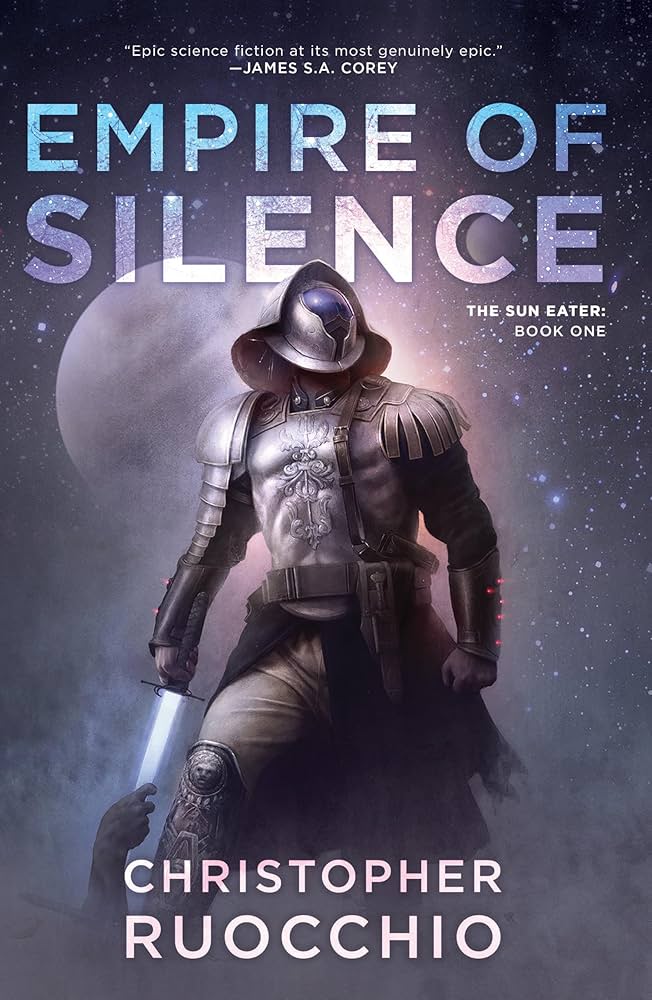
Empire of Silence by Christopher Ruocchio is an epic, world building science fiction novel. The story takes place far in the future after Earth is long gone. Humanity has spread across the stars, colonized new galaxies, and established a massive empire with strict hierarchies and social classes. Humans have evolved over centuries and now face ancient alien enemies who ruled this section of space long before humanity arrived.
The character we follow is Hadrian Marlowe, who tells his story from a jail cell 1,000 years in the future. We already know from the beginning that he is infamous for destroying a sun.
Empire of Silence is book one in the seven-book Sun Eater series, which also includes several novellas and short stories. For me, this first book felt like an extended prologue. A lot of the story is about positioning pieces on the board and setting up future conflicts.
The story is told entirely through Hadrian’s first-person perspective, but from the viewpoint of an older and wiser version of himself. He constantly hints at future betrayals, friendships, and disasters. A character may be introduced only for Hadrian to casually mention they later become his greatest ally or worst betrayer. It gives the story an interesting sense of inevitability while still leaving room for surprises.
The ending was fantastic. It takes all these characters and storylines that have slowly been building throughout the novel and finally brings them together in a satisfying way. The book ended on a very strong note for me.
Empire of Silence will not be for everyone. The book takes its time. It reminded me a lot of Tad Williams’ writing style, where the focus is on slowly expanding the world and developing the characters through their interactions. The world-building also reminded me heavily of Dune, with its ancient hierarchies, established religions, political maneuvering, and looming war against an enemy that continues to grow closer.
The story also cleverly draws inspiration from the history of the Inca and Aztec civilizations, which were associated with sun worship. In this story, the alien race has an almost anti-sun ideology. I also noticed parallels between Hadrian and Galileo, especially regarding conflict with religious institutions and ideas surrounding the sun as the center of existence.
The prose is very flowery and intentionally slows the reader down. This is not a book you can rush through. It demands patience and attention.
Ruocchio is clearly a talented writer, but there were still a few moments of lazy writing that stood out to me. At one point Hadrian literally says, “Why didn’t I think of that sooner?” and it pulled me out of the story a little. In a novel this layered and thoughtful, that moment felt oddly simplistic. The book is also around 700 pages long, and while most of it works, I think it could have lost around 100 pages and still told the same story.
Empire of Silence was first published on July 3, 2018, by DAW Books.

Why did I read Empire of Silence by Christopher Ruocchio?
I’ve seen so many friends and BookTubers praise this series. Originally, I planned to reread the Red Rising series by Pierce Brown in anticipation of Red God, but after Brown announced the book was not coming out this year, I needed another epic science fiction series to fill that gap.
I was repeatedly told that if I loved Red Rising, I would love Empire of Silence. After reading it, I actually think that comparison is misleading. Not because I disliked Empire of Silence, but because the two series are trying to accomplish very different things. Red Rising is fast-paced, action-heavy, and fueled by rage. Empire of Silence is philosophical, reflective, and focused more on ideas and introspection than nonstop action.
Plot Summary:
Hadrian Marlowe writes the story of his life from a prison cell after destroying a sun. He is the eldest son of Allister Marlowe, ruler of a planet, but he is not the favored child. That honor belongs to his younger brother Crispin.
Hadrian is intelligent, skilled in combat, and talented at negotiation, but unlike his father he dreams of knowledge and peace rather than glory and conquest. He studies languages with his tutor and even begins learning the language of humanity’s alien enemies.
After a major incident, Hadrian’s father decides his future for him by forcing him into the Chantry, a religious order where priests also serve as torturers. His mother, whose social status outranks his father’s, tries to intervene.
Circumstances eventually force Hadrian far from his wealth, privilege, and family. Stripped of status and resources, he must rebuild his life from nothing. The story follows Hadrian through a series of unexpected twists and turns as he slowly evolves into the legendary figure we know he will become.
What I Liked:
When the action scenes happen, they are excellent. Ruocchio writes action clearly and vividly, making it easy to picture everything unfolding.
The scenes involving Cat were some of my favorite moments in the novel. Honestly, they could probably have been shortened or even cut, but they provided some of the best human-to-human interactions in the story.
One of my favorite aspects of the novel was never knowing where Hadrian’s life would go next. Early on, I felt some discomfort because the story kept shifting directions, but once I embraced that unpredictability, I started really enjoying the journey.
I liked how conflicted Hadrian is about violence and how strongly he strives for peace despite living in such a brutal universe.
The ending was excellent. Seeing all the characters and plotlines come together left me genuinely excited to continue with the sequel, Howling Dark.
The prose is beautiful. It definitely slowed down my reading pace, but I appreciated how much care Ruocchio puts into the language.
What I Disliked:
The book was too long. Certain scenes could have been trimmed down without losing their emotional or thematic impact.
The line “I should have thought of that sooner” felt strangely weak compared to the overall quality of the writing and stood out in a bad way.
This novel only covers around 30 years of Hadrian’s life, which means there are still roughly 970 years left in his story. Because of that, the book often felt like one giant setup for the larger series.
Recommendation:
Empire of Silence is a strong foundation for the seven-book Sun Eater series. It establishes the world, lore, characters, and long-term conflicts very effectively. By the end, I absolutely wanted more.
The prose and terminology can feel intimidating at first, much like Dune, but the deeper you get into the novel the easier it becomes to settle into the world and writing style.
I completely understand why some readers bounce off this book early, but for me the ending delivered enough payoff, intrigue, and emotional weight to make me excited for the rest of the series.
Rating:
Empire of Silence by Christopher Ruocchio
4 out of 5
Leave a Reply