Wrap Up:
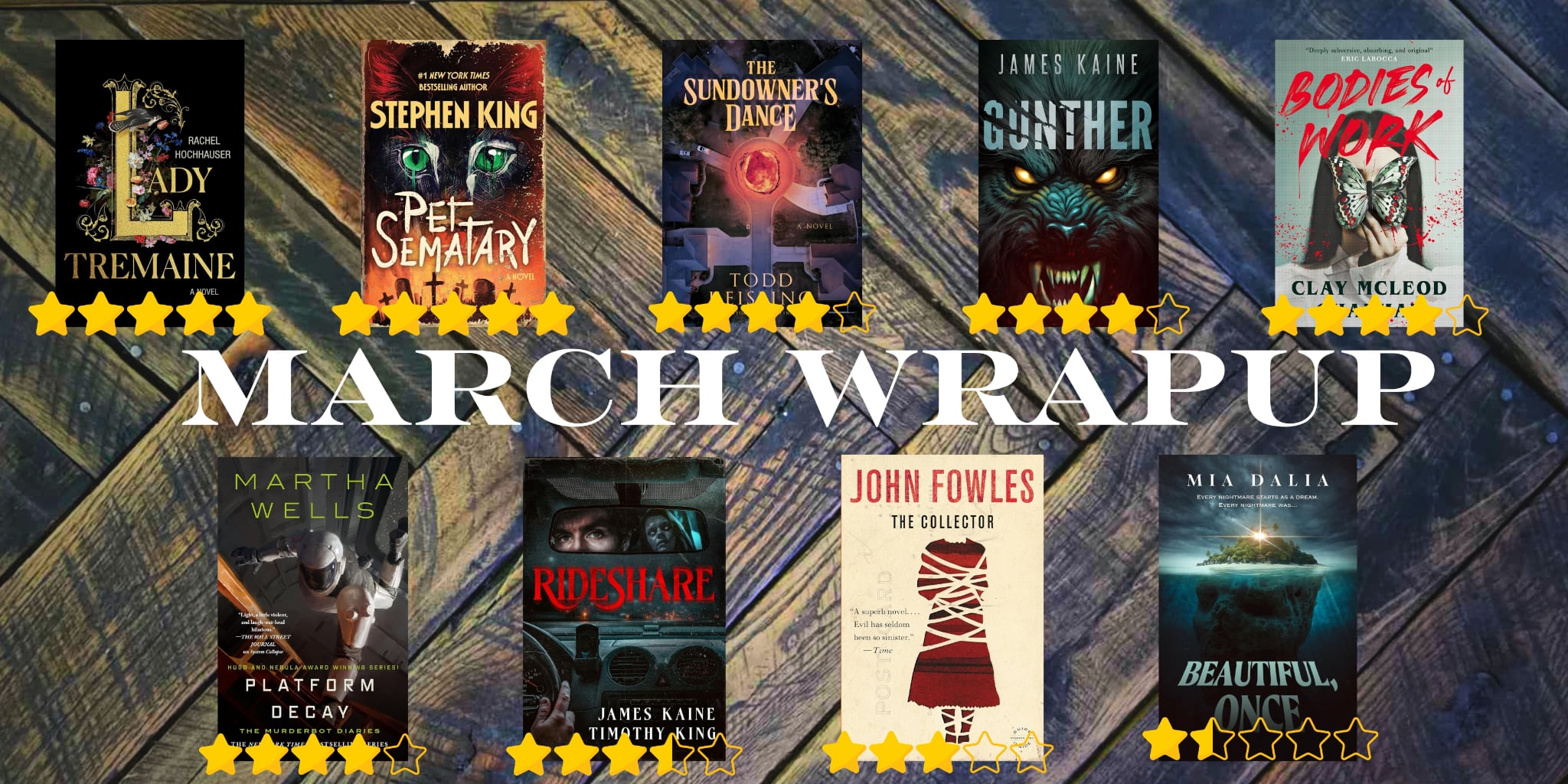
Hello Dear Readers, I had such a great month of reading, I started slow but finished fast. I read 10 out of the 11 books on my TBR.
I read 7 horror, 1 thriller, 1 science fiction, and 1 fantasy. One of the books Shy Girl found to use mostly AI, so I will not do a mini review in the wrap up, since the book is never coming out. I had two 5 stars, four 4 stars, one 3.5 star, one 3 star, and one 1.5 star.
I started using a youtube channel https://www.youtube.com/@readingwithmyeyes this month and it is going pretty well. I’m growing more confident on camera and I’m talking about my favorite thing in the world books which helps.

5 Stars:

Lady Tremaine by Rachel Hochhauser is a reimagining of Cinderella told from the stepmother’s point of view. This version removes the magical elements and grounds the story in realism. It follows many of the familiar beats of Cinderella, but where the original fairy tale ends, Lady Tremaine is only halfway through. It reminded me of Percival Everett’s James in that way, staying close to the source before branching into something new.
Lady Tremaine is a captivating character. She has been through the ringer with husbands who dismissed her wants and desires. She carries a fierce, protective energy and would sacrifice anything for her daughters, though her stepdaughter is another story.
Elin serves as the Cinderella figure, and her portrayal is where the novel takes its biggest swings. She is pale and delicate, raised to be a proper lady. Any chore is seen as cruel and unusual, something beneath her. She is easily overwhelmed, prone to fainting, stubborn, and keeps her distance from Lady Tremaine.
The book explores different perspectives on feminism, from women who sacrifice everything for their families to those who reject societal expectations and choose to live for themselves. One standout line from the queen captures this perfectly: “All wives are puppets until they learn to master the strings.”

Pet Sematary by Stephen King is a grief horror about bringing loved ones back from the dead. The tone is set early. This book is about family and death. The genius of King’s writing is getting the reader to question what they would do if a loved one died and they had access to something that could bring them back.
The theme of death is present throughout the entire book. Even during the happier moments, death still lingers in the background. It feels as if death itself is knocking on the door. The phrase “sometimes dead is better” is repeated often. It refers to the idea that some people and some things are better left buried.
Jud Crandall might be my favorite Stephen King character. With his deep Maine accent, he serves as both the moral center of the story and the catalyst for the events that follow.
Pet Sematary is widely considered Stephen King’s darkest novel. The ending reflects the heavy subject matter. King originally did not plan to publish the book because he felt it went too far. His publisher was unhappy with Different Seasons, and King still owed them one more book under contract, so he handed over Pet Sematary.
4 Stars

The Sundowner’s Dance by Todd Keisling is a cosmic horror novel set in a retirement community. The story is one part a heartbreaking look at aging and fading memories, and the other part a cult-worship horror tale featuring creatures straight out of a living nightmare. Despite the terror, the novel has a surprising amount of heart as it asks an emotional question: how do you move on after losing the love of your life? And should you?
The novel takes an interesting look at dementia. The title The Sundowner’s Dance refers to the phenomenon where dementia symptoms worsen after dark. Keisling uses this idea to highlight the horror of not knowing whether someone is a friend or a foe. At one point the story compares the mind under dementia to being worm food, and since this is a horror novel, it has some fun with that concept. One of the trigger warnings even jokes about “gratuitous wormage.”
The basic plot follows a man who moves into a retirement community after the death of his spouse. He is searching for peace and quiet. Instead, he discovers a moon-worshiping cult.

Gunther by James Kaine is a prequel novella to My Pet Werewolf. In that novel Gunther is the catalyst for all the events that occur. In this novella Gunther is not a pet but the main focus. At the end of My Pet Werewolf we learn that Gunther once had a name, Dr. David Bixby.
Gunther asks the question: what if a good man were bitten by a werewolf. Dr. Bixby is a man who dedicated his life to saving people. After the bite he begins to feel the urge to take lives instead. The werewolf disease amplifies other urges as well, including sex, violence, and aggression.
The story unfolds like a slow version of Breaking Bad as it explores the psychology of a good doctor slowly becoming more aggressive and dominant as the lunar cycle approaches. I especially enjoyed the scenes where the doctor fights against these new urges.

Platform Decay by Martha Wells is the eighth book in the Murderbot Diaries. The series follows a SecUnit, a security robot designed for protection and killing that happens to look human. After a glitch frees it from its programming, Murderbot no longer wants to kill and instead chooses to protect. It has also made it a mission to free other SecUnits.
Platform Decay opens like a Mission: Impossible sequence. Murderbot must infiltrate a planet surrounded by a substation. With multiple distractions happening at once, it finds a way to slip in unnoticed.
The mission centers on extracting members of Dr. Mensah’s family, but there is a complication. Someone on the inside, someone Murderbot knows all too well, is aware of the family and has their own conditions. This makes an already difficult mission even more complicated.
This is largely a solo mission. Three helps at the beginning, but after that Murderbot is mostly on its own. That used to be fine for Murderbot, but it has started to rely more on its team, and that absence is felt.

Bodies of Work by Clay McLeod Chapman is a horror novella about haunted, stolen voices. Winston, a quiet church janitor, believes he is on a mission from God to kill women and send their souls to fight a battle in the Nether Realm. In simpler terms, Winston is deeply unwell.
The novella works as a character study of a fractured and disturbed mind. It takes an interesting approach to the idea of battling oneself, or more specifically, battling for control of one’s own mind.
Chapman is a talented writer because, as unhinged as Winston is, his past is so heartbreaking that it is hard not to feel some level of empathy for him.
The voices are a central element of the story. After Winston kills these women, he preserves their final words in jars, and their voices continue to live inside his head, fighting their own battle. These voices act as a kind of commentary on the events of the story, but they also begin to break through Winston’s mental barriers, haunting him for what he has done.
3.5 Stars

Rideshare by Timothy King and James Kaine is a novel that connects four short stories through a rideshare driver. Charlie the driver is our entry point into the stories. Once he picks up a passenger there is some banter back and forth, then we get the story of the passenger and why they are taking the ride.
This is a dual author novel, with each writer contributing two stories to Rideshare. You can feel the enthusiasm of two horror writers trying to outdo each other. When the characters make a sadistic smile you can almost imagine the authors making the same smile as they gleefully write the mayhem and gore.
The horror covers a lot of ground because the stories are based on the seven deadly sins. There is body horror, supernatural horror, grief horror, and psychological horror.
The best way I would describe Rideshare is like the anthology films Tales from the Crypt and Creepshow, where the stories are loosely tied together until the end and there are small vignettes between each story.
3 Stars

The Collector by John Fowles is a novel about obsession and collecting. Published in 1963, it was likely considered a thriller at the time, centered on a butterfly collector who decides he wants to collect something else: a beautiful woman.
The book explores the difference between surface-level love and deep love. The collector is drawn to the appearance and idea of the woman he has taken, but rejects the reality that she is a complex person with thoughts and emotions. He would prefer she remain still, pretty, and silent.
He wants her to love him, not make love to him, but accept him despite his many flaws. I believe the protagonist presents as a depressive asexual with anxiety issues, though I do not think these ideas were widely understood or discussed in 1963.
The story feels like a much slower version of You by Caroline Kepnes, focusing entirely on imprisonment without the charm or charisma.
1.5 Stars

Beautiful, Once by Mia Dalia is a horror and science fiction novel about an island utopia that encounters a foreign object. The book is light on both horror and science fiction but heavy on themes about society, which in some ways can be more unsettling.
The novel asks deep questions about how society functions and how humans might build something better. It explores ideas surrounding Marxism, small government, and immigration. At times, it even suggests that the world might be better off if left to animals.
The core premise is simple: what happens when an island utopia is disrupted by an alien object that may be a weapon.
The balance between genres is where the book struggled for me. Horror makes up about 20 percent of the story, while discussions about society take up the other 80 percent. I enjoy social commentary, but this ratio did not work in a horror novel.
Leave a Reply