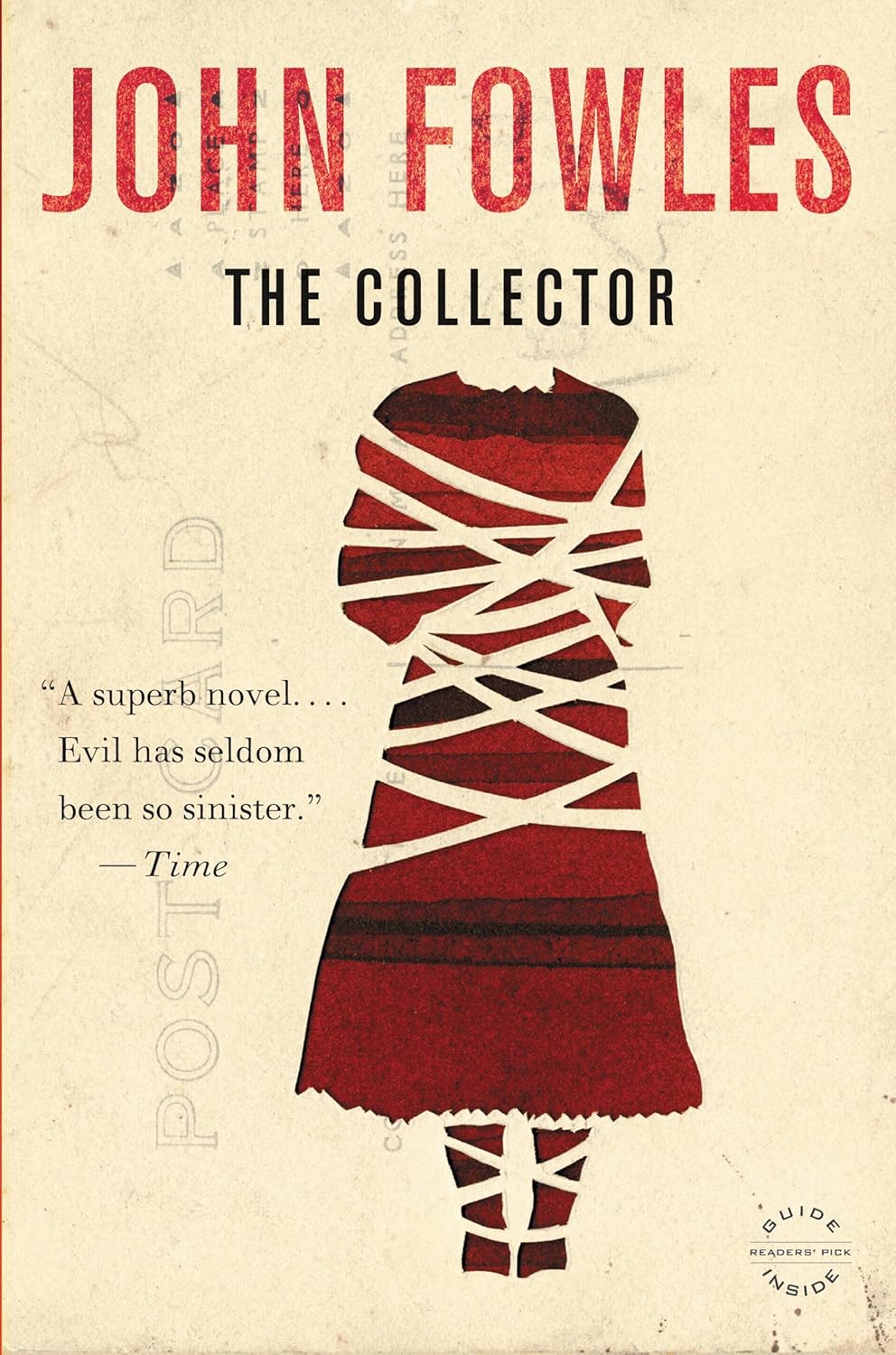
The Collector by John Fowles is a novel about obsession and collecting. Published in 1963, it was likely considered a thriller at the time, centered on a butterfly collector who decides he wants to collect something else, a beautiful woman.
The book explores the difference between surface level love and deep love. The collector is drawn to the appearance and idea of the woman he has taken, but rejects the reality that she is a complex person with thoughts and emotions. He would prefer she remain still, pretty, and silent.
He wants her to love him, not make love to him, but accept him despite his many flaws. I believe the protagonist presents as a depressive asexual with anxiety issues, though I do not think these ideas were widely understood or discussed in 1963.
The story feels like a much slower version of You by Caroline Kepnes, focusing entirely on imprisonment without the charm or charisma.
The Collector is a British novel, and as an American, I was initially confused by the term “pools,” referring to betting pools rather than swimming pools. This was only an issue early on and becomes clearer as the story progresses.
The novel is told through two perspectives: Frederick, the collector, and Miranda, the woman he abducts. The narrative is split in half. Frederick’s perspective runs from before the abduction through the end, followed by Miranda’s perspective from her capture to the same endpoint. Frederick ultimately has the final word.
The pacing is very slow. What may have been a gripping thriller in 1963 now reads more like a slow but somewhat interesting character study. Its claim to fame is often being considered the first psychological thriller.
The Collector was first published on May 1, 1963.
Why did I read The Collector by John Fowles?
I read The Collector because Clay McLeod Chapman’s novella Bodies of Work is inspired by it. I wanted to enhance my appreciation of that work.
The novel’s reputation as the first psychological thriller also made it appealing to me.
Plot Summary:
Frederick, 25, is a lonely butterfly collector who has recently come into a large sum of money. With no need to work, he becomes fixated on Miranda, a 20-year-old woman he views as a beautiful free spirit. He purchases a secluded house in the countryside and abducts her. Frederick claims he loves her, but what he truly values is her beauty rather than her full identity. Miranda must navigate captivity while trying to find a way to escape without triggering his fragile mental state.
What I Liked:
The comparisons between collecting butterflies and collecting women are effective and unsettling. They reveal how Frederick rationalizes his actions.
I appreciated the exploration of different forms of love. Both characters are trying to define what love means, with Miranda reflecting on a past relationship and Frederick attempting to justify his feelings.
The novel examines the psychological toll of captivity, including the exhausting mental process of constantly planning an escape and the risk of identifying with one’s captor.
The ending reminded me of You. Frederick shares similarities with Joe Goldberg, though he lacks charm, charisma, and any sense of romance. Their approach to moving on from love feels comparable.
Miranda’s perspective is the strongest part of the novel. Her internal struggle and psychological response to confinement are compelling, though I wish more time had been spent there.
What I Disliked:
The pacing is extremely slow. While it may have been engaging at the time of publication, it feels drawn out by modern standards.
Miranda’s flashbacks, particularly her relationship with an older man, were only mildly interesting, and I did not enjoy how that storyline was presented.
Although the butterfly metaphor is effective, I wanted more detail. Showing the process of collecting would have strengthened the parallel instead of keeping it mostly implied.
Recommendations:
The Collector is an important but uneven read. As a thriller, it feels dated, but as a character study, it still has value. I am glad I read it, especially in connection with Bodies of Work, but it is not something I would strongly recommend. If you are interested in early psychological thrillers or dark character studies, it is worth considering.
Rating:
The Collector by John Fowles
3 out of 5
Leave a Reply