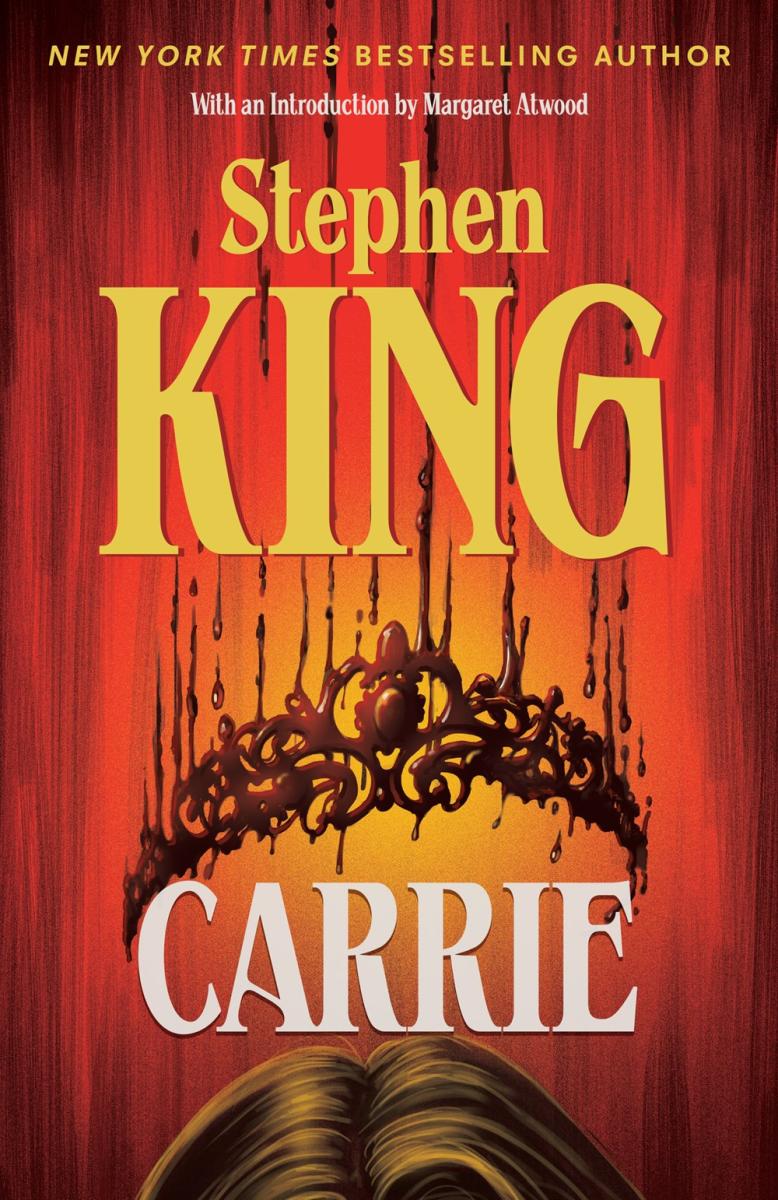
Carrie by Stephen King is a novel about a troubled girl with special powers. Carrie’s story is a tragic one, the story of a villain shaped and forced into that role by society. The heartbreaking part is that everything could have been prevented. If the people around her had offered compassion instead of cruelty, the blood would not have flowed. Carrie is both a character study and a sociological experiment played out by the entire town of Chamberlain.
Carrie is told in a docudrama style, which I had forgotten. The story unfolds through newspaper articles, biography excerpts, interviews, police reports, and Carrie’s own perspective. This format works extremely well leading up to the prom. Afterward, though, I felt the aftermath relied too heavily on outside voices from townspeople we had not previously met.
The symbolism of childhood turning into womanhood runs throughout the novel. King uses religion, prom, and a baptism of blood and fire to explore that transformation. In terms of metaphor and theme, Carrie might be some of King’s best writing, especially in the first half.
The novel features memorable characters: Sue Snell, Chris Hargensen, Margaret White, and Carrie White herself. On this reread, Carrie’s mother was far scarier than I remembered. I cannot imagine spending even a few minutes alone with her, let alone an entire lifetime like Carrie did. Margaret White is the true villain of the story.
Like The Shining, Carrie is often remembered more for its film adaptations than for the source material. The Shining suffers from this more, but both novels are surprisingly different from their movies. Carrie herself is described as chubby, not the lithe teen the films portray. The novel’s ending is also told out of chronological order. With Mike Flanagan set to direct a miniseries adaptation, I am curious to see how much of the book’s structure and detail will finally make it to the screen.
Carrie is paced extremely well. It is short enough to finish in one sitting, and it flows smoothly. King does not use the numbered chapter breaks he later became known for, but the mixed-media format naturally creates pauses every few pages, making it very easy to consume.
The ending could have had more impact. By the time the main villains, real or perceived, are gone from Carrie’s life, we get one final emotional moment that works, but I wanted it to hit harder.

Why did I read Carrie by Stephen King?
Carrie is a reread for me. It has been almost 20 years since I revisited this classic. The fact that it was written over 50 years ago still amazes me.
I reread it because I received an ARC of Monsters in the Archives by Caroline Becks, which releases on April 21, 2026. What makes that book special is that Stephen King granted access to his private archives and drafts for the first time. It focuses on five of his works: Carrie, Salem’s Lot, Pet Sematary, The Shining, and Night Shift.
Plot Summary:
Carrie White is an outcast, the quiet girl everyone notices but no one truly knows. She is raised by Margaret White, a deeply religious woman who sees sin in everything. Margaret is haunted by her one moment of “sin” and reminds Carrie daily that she is the result of it.
After gym class, Carrie experiences her first period in the school shower. Not understanding what is happening, she believes she is dying. The other girls know the truth and respond with cruelty, taunting and humiliating her until the coach intervenes. In the chaos, Carrie shatters an overhead light with her emerging telekinetic powers.
Sue Snell, one of the girls involved, later feels guilty when she realizes Carrie had no understanding of what was happening to her. To make amends, Sue convinces her boyfriend to take Carrie to prom. Chris, the ringleader of the bullying, wants revenge, and she plans to get it at prom.
What I Liked:
The writing is incredible. King paints vivid pictures of people and places, and his word choices feel deliberate and precise. It is no surprise this novel has endured for decades.
The metaphors of baptism, womanhood, and blood are woven seamlessly into the story. Religion ties everything together in a way that feels organic rather than forced. Carrie deserves to be studied for this alone.
Margaret White is terrifying because of her conviction. In her mind, she is the hero of the story, battling Satan at any cost, even if that cost is her own daughter. She recognizes her role in Carrie’s unraveling but justifies it as righteous action.
Part 1: Blood Sport is some of King’s best writing. He builds the town and its treatment of Carrie and her mother so effectively. The foreshadowing makes it clear this story will end in tragedy, yet as a reader, I still found myself hoping it might turn out differently. That Chris and Billy might choose someone else. I also liked that Billy is motivated purely by chaos. He does not care who suffers, he just wants to watch it happen.
What I Disliked:
The aftermath of the prom could have been structured better. I liked the content itself, but I would have preferred Carrie’s internal thoughts to be interwoven with the survivors’ reactions. The sequence of survivor testimony, town commentary, and Carrie’s perspective removed much of the surprise and distanced me from her emotionally.
Carrie and her mother’s final confrontation felt too brief. Once that scene ended, the central conflict seemed to dissolve too quickly.
I also wanted more from Carrie’s encounter with Chris and Billy on the road. That revenge moment should have carried more weight, even if Carrie did not know they were responsible.
The book’s final scene with Sue Snell was good, but I wanted more buildup. This is one area where the 1976 film adaptation excels. It allows Carrie to confront the true villain while still giving us that final moment with Sue.
Recommendation:
Carrie is a must-read for Stephen King fans. It is short, fast-paced, and packed with powerful themes. The first half contains some of my favorite King writing. While I think the second half could have been structured more effectively, the issue lies more in arrangement than in quality. I recommend all my followers read Carrie by Stephen King.
Rating:
Carrie by Stephen King – 4 out of 5 stars
The first half is 5 out of 5 stars. The second half is 3 out of 5 stars.

Leave a Reply